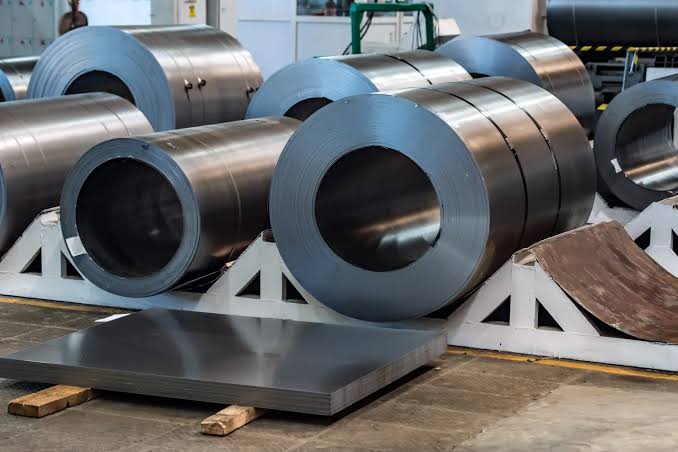
Steel is one of the most widely used materials in construction, manufacturing, automotive production, and infrastructure. Not all steel products have the same properties or applications. There are two types of common steel: hot rolled steel and cold rolled steel. Both of these look and feel similar. Yet the making process gives them different characteristics.
Understanding the differences between hot rolled and cold rolled steel can help businesses, fabricators, engineers and construction professionals choose the right material for their specific requirements.
What Is Hot Rolled Steel?
Hot rolled steel is produced by heating steel above its recrystallization temperature and passing it through rollers to achieve the desired thickness and shape. Because the steel remains hot during the rolling process, it can be processed more easily into large sections and different forms.
Hot rolled steel is commonly available as sheets, plates, bars, and structural sections. It is widely used in construction, infrastructure, heavy machinery, railway components, and industrial fabrication. Also read: How to Choose a 3D Printing Service in Perth: A Buyer’s Scorecard
One of the main advantages of hot rolled steel is its suitability for applications where precise dimensions and surface appearance are less important than strength, versatility, and cost-effectiveness.
What Is Cold Rolled Steel?
Cold rolled steel starts as hot rolled steel that undergoes additional processing at or near room temperature. The material is further rolled to achieve tighter dimensional tolerances and a smoother surface finish.
Because of this additional processing, cold rolled steel generally offers better dimensional accuracy and surface quality than hot rolled steel. It is frequently used in applications where appearance, precise measurements, and consistent thickness are important.
Common applications include automotive components, appliances, furniture, electrical products, and precision engineering. Also read: Everyday Gold Buying Trends in Two Distinct Districts
Key Differences Between Hot Rolled and Cold Rolled Steel
1. Manufacturing Process
The primary difference is the temperature at which rolling takes place. Hot rolled steel is processed at high temperatures, while cold rolled steel undergoes additional rolling at much lower temperatures.
Cold rolling requires additional processing, which generally makes the product more dimensionally precise.
2. Surface Finish
Hot rolled steel typically has a rougher and less uniform surface because of the high-temperature manufacturing process and subsequent cooling.
Cold rolled steel has a smoother and cleaner surface, making it more suitable for products where appearance and surface quality matter. Also read: From Idea to Platform: How Fintech Software Is Built for Scale and Compliance
3. Dimensional Accuracy
Hot rolled steel can have greater dimensional variation because the material contracts as it cools after rolling.
Cold rolled steel provides tighter dimensional tolerances because it is processed further after the initial hot rolling stage.
4. Strength and Formability
Both types can offer good strength, but their mechanical properties can differ depending on the grade and processing method. Cold working can increase hardness and strength while reducing some of the material’s ductility.
Hot rolled steel is often preferred for heavy structural applications where formability and large-section production are important. Also read: Выбор надежного стыкового аппарата для полиэтиленовых труб
5. Applications
Hot rolled steel is commonly used for structural beams, columns, plates, railway tracks, heavy equipment, and construction components.
Cold rolled steel is more commonly used for automotive body panels, appliances, cabinets, furniture, and other products requiring a smoother finish and greater dimensional precision.
6. Cost
Hot rolled steel is generally more economical because its manufacturing process requires less additional processing. Cold rolled steel usually costs more because of the extra rolling and finishing stages required to achieve tighter tolerances and improved surface quality.
Which One Should You Choose?
The choice between hot rolled and cold rolled steel depends primarily on the intended application. For large structural components, heavy fabrication, construction, and projects where cost and strength are major considerations, hot rolled steel can be a practical choice. Also read: What Strong CRM Governance Looks Like in Modern Teams
For applications requiring precise dimensions, smoother surfaces, and consistent appearance, cold rolled steel may be more suitable.
Ultimately, buyers should consider factors such as required dimensions, steel grade, surface finish, mechanical properties, application, and budget before selecting a product.
Understanding these differences makes it easier to choose the right steel for a project while balancing performance, quality, and cost.